Showing posts with label Nature. Show all posts

October 26, 2009

Agraulis vanillae


This is the Gulf Fritillary, sometimes called the Passion Butterfly. (Family Nymphalidae, sub-family Heliconiinae.) Earlier this month and throughout most of September there were quite a few around here. Evidently, they aren't easily startled, and were fairly easy to photograph. They fly pretty high above the ground compared to lots of other butterflies I've studied.

Here's a close up of the underside of both the upper and lower wings. Notice the dark 'eyespot' on the third and largest white oval marking on the lower wing. A very distinguishing characteristic.

September 18, 2007

Intelligent Design

Two days ago a good friend of mine, knowing that I am interested in butterflies, sent me these pictures of two absolutely GORGEOUS specimens that a friend photographed in Italy.

I adore butterflies. They are one of the most interesting, beautiful creatures on earth. They ought to be called 'flying flowers' though some of them can be prettier than the prettiest of flowers. These ones are the loveliest I have seen yet.


EDIT: A fellow blogger was kind enough to identify these specimens for me. Thank you very much Biologist. The top picture is a female Attacus atlas (an atlas moth) one of the largest moth species in the world. The second one is some kind of swallowtail butterfly (Papilliodae.)

September 14, 2007

Melitaea didyma (Spotted Fritillary)

Found in Black Sea region.

I photographed this Fritillary sometime back in July, but I kept it in my pictures meaning to post it and never did. Today I thought of it again so here it is. It is actually the first butterfly I have ever photographed and the first one I have ever caught since at least three years ago. Fritillaries really are very pretty. Most of them are a combination of orange and black, like this one, but occasionally they differ. The one I caught seemed to be almost tame, it was so bold. If I was quite still, it would sit there on my finger without flinching for a considerable time. It was the easiest thing to catch; I do not even have to use a net for these ones, I just close my hand over it, and then open it gradually and it will sit on my finger. It is also extremely co-operative in that it lands with its wings open. I never learned how important that was until I had had experience catching numerous others who never open their wings. I think the Swallowtail and the Fritillary are my favorite ones.

Also, we have sixteen days left to choose our favorite authors on the poll that you will find on the sidebar. You can only vote once, but for as many candidates as you choose. So, go check it out!

August 30, 2007

Vanessa atalanta - (Red Admiral)

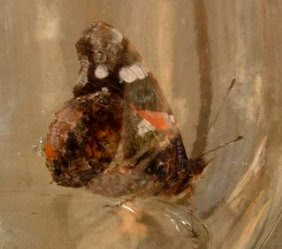
I am sorry these pictures are such poor quality, but I couldn't get very clear ones, as the butterfly moves very fast and never seems to stay still. He really is very pretty though, and when you seem for real he is a very bright red. I have been trying to photograph him ever since I saw him two months ago. (And I never did catch him, my friend did.) He seems to be a very intellegent butterfly and he has slipped out of my hands more times than I would like to recall! But I have got a picture at last, and even though it is a very poor one I thought the butterfly was just too beautiful to be passed up.

Found in Northern Turkey.

These pictures hardly do the creature justice, so I am giving you another one so that you can see what it really does look like.

(taken from eurobutterflies.com)

If you are interested, than I encourage you to go to Mr. Matt Rowling's butterfly site dedicated to European butterflies. He has done a great job, and created a very resourceful site with dozens of pictures of BEAUTIFUL butterflies from all over Europe.

July 25, 2007

Argynis pandora (Cardinal)

This is the prize butterfly I have been trying to photograph for awhile. It is not quite as pretty as my Scarce Swallowtail, but I think it has second place on the list. It has a strong flight, and I was never able to take it before. It is very large, and I thought that the patterns on both sides are quite unique. What's more, it was extremely cooperative when I tried to photograph it!


This one is rather blurry but if you look closely you can see the butterfly's proboscis slightly extended.

Take a look at those green eyes!

Unidentified Blue

Found in Black Sea region. I am not 100% sure of this identification. I know that it is some kind of blue, and I have researched the butterfly and the Vogel's Blue, (below) resembles it closely. However, if you look carefully, you can see that the black markings on the side of the wing differ considerably.

(Picture taken from eurobutterflies.com)

The Spalding's Dotted-Blue (Euphilotes spaldingi) (below) is a more probable possibility. I could not find another picture of it, though, and I am not sure if this one is very dependable, as it has a reddish light to it, which is probably film lighting, but could be the natural color of the butterfly.

(Picture taken from butterfliesandmoths.org)

July 20, 2007

Colias Lepidoptera (Unidentified)

My young brother caught this butterfly for me yesterday. It is evidently some kind of Colias, but I am not sure what kind and, as yet, I have been unable to identify it. Because of the color of its wings and the familiar white and brown markings in the center, it identifies itself as some kind of clouded butterfly. Most likely a clouded yellow, but I do not know what specific species. If anyone knows what species it is, I would be glad to hear.

It looks very much like a Colias aurorina (Greek clouded butterfly) that I posted some time ago, but it does not have the yellow color that the other posseses. The unique patterns on its closed wings are evident in the picture, but it has a fairly strong flight, and I was unable to take a good picture of its open wings. I have heard that these are hard to photograph with open wings. There is one below, but it is rather blurry. When its wings are open, the upper ones are white with a small black spot in the center and wide black edges that have at least two small white markings, and one pale yellow marking. I was unable to closely examine the lower wings due to the butterfly's constant flight, but I could see that the lower wings are also white, with black edges that contain a fairly large orange marking and at least two small white ones.

July 18, 2007

Underneath the Surface


Yesterday I found a hollyhock on the roadside. It had grown there on it's own, and it was not planted or cared for by anyone. But it has become one of the awesome wonders of nature. Lets get a closer look.

Its rather wilted on the edges, but the splendor of the color is evident. Lets look under the surface, a little deeper.

Now it no longer looks wilted, but the color and the symmetry of the lines give it a beautiful appearance. A little deeper.
It isn't a dusty little flower by the roadside anymore. The cloudy, pale color at the very middle of the flower, getting darker and stronger as it goes further. The lines are all perfectly placed. The pearly green and the light, pale pollen in the center give a finishing touch. It looks like mother-of-pearl inside. Use your imagination and picture it as a fairy tree from the Midsummer Night's Dream with yellow leaves. There are so many words we can describe it with. Beautiful, fantastic, awesome. The true character of the flower is underneath the surface. This is normally missed, and we only see the surface. But when you get underneath the surface, the whole world changes. We too often pass the details over and miss the real picture. I think that whoever named this flower 'hollyhock' must have not looked very far beneath the surface. It deserves a much more romantic name that echoes its true beauty. But I suppose there isn't anything we can do about that except try to find the other side of everything ourselves.

July 3, 2007

Artogeia rapae (Small White)

Found in Black Sea region. Uncertain identification. Resembles the Small White. Its principal diet is cabbage leaves.

Caterpillar

Found in Northern Turkey. Caterpillar found eating rosebush leaves. Unindentified. If anyone knows what its name is, I would love to know.